
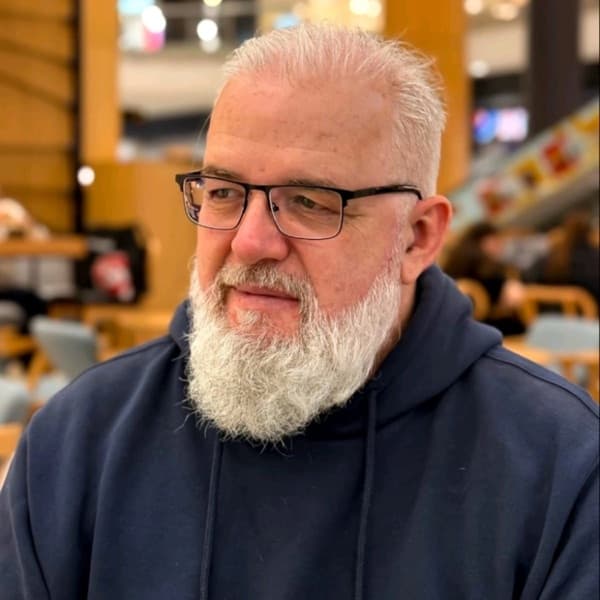
The story of Joe Kristiansen
Thirty schools and the search for an anchor
Joe attended more than 30 schools while growing up because his father's welding work moved the family from job to job. Repeatedly entering a new class taught him to read social structures quickly and adapt his behavior, but it also pushed his own identity into the background. A neighborhood mentor, a former United States Marine named Bob, gave Joe a stable lesson about keeping his word. Reading, creative writing, mathematics, science, aviation, and motorcycles became lasting interests.
At 17, with college not yet accessible and few settled plans, Joe joined the Canadian military. The relative stability of military postings slowed the constant movement. It also gave him a practical career, a team, and eventually a way to connect technical ability with work that carried visible public purpose.
Search and rescue, loss, and systems that serve people
Joe began in artillery, then moved into Air Force electronics and spent about 13 years supporting search and rescue aircraft. The work taught him to value the contribution of each link in a chain, including routine maintenance that allowed a later mission to locate a crash site. A separate aircraft accident killed his best friend and other crew members, prompting a deeper look at family, home, and the lack of an anchor in his own life.
He earned Java certifications, took leave to teach J2EE application architecture through IBM, and returned with new ways to automate military processes. With mentors and colleagues, he helped turn a month long readiness reporting cycle into an on demand system. The experience reinforced process, adaptable goals, mentorship, and satisfaction in useful work rather than public recognition.
Measuring AI outputs with CMEF
Joe created CMEF after identifying a gap in enterprise AI systems: large language models can produce confident errors, while users often lack an independent way to measure, reproduce, or audit what happened. CMEF is designed as a model agnostic observation layer that scores outputs, records evidence, and lets an organization decide whether to allow, warn on, route, or block a result. It does not depend on access to a model's private internals.
Joe has a functioning alpha and is working toward a beta that can run as a service or inside a customer's stack. His immediate goals include securing expressions of interest, raising development funding, and building the beta with the versioning and release discipline used in the risk industries he comes from. He frames the work as risk measurement and mitigation rather than a promise to make AI safe.